
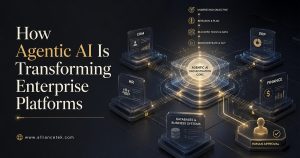
The majority of enterprise software is still dependent on human intervention to initiate any activity, transfer information between different systems, and perform activities that require making a decision. The process of traditional automation can accelerate any predefined process, but it usually operates on rules already established by users. If the workflow changes or requires information from a different system, a person should intervene.
Agentic AI is changing this situation. An AI agent does not just provide a response or a fixed sequence but can comprehend the objective of the process, collect necessary information, use connected instruments, perform specific activities, and engage a human whenever the process requires human intervention. All these qualities make agentic AI especially interesting for enterprise platforms, where processes usually include CRM, ERP, HR, finance, and many other applications.
In this post, we will learn what agentic AI is, how it differs from generative AI and traditional automation, its use cases by enterprises, and the key issues businesses need to consider when adopting agentic AI in their workflows.
What Is Agentic AI?
Agentic AI refers to artificial intelligence systems that can plan and perform various actions to achieve a certain objective. The AI agent is an advanced form of chatbot because it can operate inside enterprise software, get data, and act accordingly.
For example, it can receive requests, search for data in the company’s CRM, check the account details, and pass the request to the right department. This makes the process more efficient by reducing manual operations.
An enterprise can leverage Agentic AI development services to build AI agents over their workflows and connect them to enterprise software.
A Brief About Agentic AI Development Services
Agentic AI development services typically include:
- AI Agent Development
- Multi-Agent System Development
- Agentic AI Consulting
- AI Agent Integration
- Workflow Automation
- AI Agent Orchestration
- Ongoing AI Agent Support
How Is Agentic AI Different From Generative AI?
In the context of generative AI and agentic AI, artificial intelligence models play an important role, although their applications are different. Specifically, while generative AI focuses on the creation/interpretation of information, agentic AI utilizes the abilities of AI to comprehend a goal and perform required actions in relation to the linked systems.
| Dimension | Generative AI | Agentic AI |
| Primary purpose | Generate or interpret information | Complete a goal through reasoning and action |
| How it works | Responds to prompts and produces an output | Understands a goal, plans steps, uses tools, and takes actions |
| Decision-making | Provides information or recommendations | Can determine the next appropriate action based on context |
| System access | Can access external systems when specifically integrated | Designed to use APIs, databases, and enterprise applications as part of a workflow |
| Output | Text, code, summaries, recommendations, or other generated content | Actions, completed workflow steps, updates, and responses |
| Example | Drafts an email for a customer | Reviews customer data, drafts the email, verifies the information, and sends it when permitted |
Key Components of Agentic AI
Agentic AI is not dependent upon the AI model. Enterprise AI agents involve the use of the AI model, along with context, connectivity, tools, orchestration, and security controls to make sense of what needs to be done next.
The main components that enable it to perform its function include:
- AI models
- Memory and context
- Tools and APIs
- Orchestration
1. AI models
An AI model is the decision-making unit of an agent. It evaluates the inputs, applies the contextual information, and decides the best course of action.
Depending on the task’s complexity, various models can be used in enterprise IT, including different levels of accuracy, speed, cost, and security.
2. Memory and Context
An agent can be instructed to perform a task based on specific input data, conversation, customer’s history, or documents.
Contextual data must be appropriately secured and only available to authorized users while remaining relevant to the task at hand.
3. Tools and APIs
Tools give AI agents their functionality, allowing them to perform tasks within enterprise IT applications. Thus, an agent can access customer relationship management (CRM), enterprise resource planning (ERP), databases, ticketing systems, and other business systems via APIs.
They enable an AI agent to accomplish a task, not just recommend it.
4. Orchestration
Orchestration is the process of designing, managing, and executing a series of tasks accomplished by an agent or multiple agents.
It is critical in enterprise IT to prioritize steps and decide which tool to use and when, particularly when dealing with multiple tools or specialized agents.
How Enterprises Are Using Agentic AI
The use of Agentic AI applies to various business operations involving repetitive and structured activities across different systems.
1. Customer Support
AI agents can classify support queries, access customer details, access account details, and offer solutions. They can also manage regular queries and pass on complex queries to humans along with information.
2. Document Processing
Every firm is always working on contracts, invoices, claims, reports, and other paperwork. AI agents can help in extracting data, comparing documents, identifying missing data, and routing exceptions to the right individual. This can cut down the amount of time required to review and process documents manually.
3. IT Operations
The IT department can use AI agents for managing routine requests and incidents. An agent can analyze a request or ticket, review system details, access the company knowledge base, and suggest remediation. More complex issues can be escalated to IT personnel.
4. Finance & Operations
The finance department can use agents for invoice reconciliation, expense review, vendor management, and procurement approvals. The agent can extract data from multiple sources and automate routine processes while reporting exceptions.
How Agentic AI Works With Enterprise Platforms
Agentic AI is more valuable when it is integrated into the systems that workers use currently.
It means that an enterprise agent may communicate with CRM, ERP, HR, finance, database, and other internal apps via API and allowed tools. It may receive necessary data and take actions depending on its permissions.
For instance, an onboarding employee agent may gather information about a new worker, create his/her record in the HR app, send necessary documents, and inform the IT department about preparing access for him/her.
This way, Agentic AI solutions are able to be integrated into existing enterprise workflows, rather than working as separate AI solutions.
Common Agentic AI Solutions for Enterprises
Businesses can apply Agentic AI solutions across different enterprise functions, such as:
- Intelligent Document Processing
- Business Process Automation
- Customer and Employee Agents
- Cybersecurity Agents
- Regulatory and Compliance Automation
What Are the Benefits of Agentic AI?
Agentic AI may bring the following advantages, provided that the right processes are chosen for such an application:
- Less manual work: Agents may perform routine tasks.
- Shortened processes: Automated tasks help eliminate time lags.
- Increased productivity: Workers will be able to concentrate on activities that require judgment.
- Consistency: Agents may perform according to pre-specified processes.
- Scalability: More tasks may be handled without proportionally increasing the volume of manual labor.
The above-listed benefits depend on the process, the quality of data, system integration, and degree of automation.
Why Governance Matters for AI Agents
Agents that utilize AI technology have access to enterprise data and the ability to take action. That is why security and governance issues are critical at the outset.
It is essential for businesses to decide what data and actions are allowed for each specific agent. Agents should be given permissions only to what is needed for performing their duties.
Certain high-impact actions may also require human approval. For example, financial transactions and modifications to sensitive data can be performed only after an employee approves the agent’s proposal.
Logistics of such actions are also crucial. Businesses should be capable of monitoring what an agent did and detecting any mistakes and unintended behavior.
How Businesses Can Prepare for Agentic AI
Agentic AI consulting provides support for businesses to find appropriate applications of AI technology and plan its deployment effectively. The analysis includes evaluating the current processes, data sources, technological setup, integration capabilities, and security needs to understand how AI agents can provide value addition.
This analysis will typically begin with routine and rule-based activities that may be automated. The goals of the agent, tools required, access needed, points of human intervention, and measures of success can be determined by the consultant.
Focusing on one activity can allow businesses to deploy the agent for one process and measure improvements in processing times, operational expenses, response times, and worker productivity.
Key Considerations Before Implementing Agentic AI
Companies must assess their systems and work methods before using agentic AI. By taking the appropriate measures, efficiency can be boosted; an incorrect strategy could lead to problems regarding security, connectivity, and operations.
1. Data Quality
The functioning of AI agents largely relies on the healthy and effective management of information. Businesses need to evaluate the sources of their data to address issues such as obsolete, duplicated, or insufficient data before implementation.
2. Systems Integration
To run properly, the agents need to be established in the applications involved in the processes. Systems such as CRM, ERP, databases, and other enterprise tools should have secure integrations through approved tools or APIs.
3. Security and Permissions
Every agent has to be assigned access permissions. Limiting access to the necessary systems and data required for executing a task will help cut down the security risks.
4. Human Control
Not all the decisions have to be automated. Businesses must determine which tasks require human approval and set the protocols for dealing with exceptions or actions of a high level of risk.
5. Performance and ROI
Businesses must set measurable objectives before implementation. Processing times, costs of operations, errors, response times, and productivity of workers will allow evaluation of the effectiveness of the agent and its capability in bringing significant business value.
Building Autonomous AI Systems for Enterprise Workflows
With increased capabilities of AI agents, companies are now turning towards Autonomous AI systems, where AI agents can perform a larger number of business processes without the involvement of humans.
Nevertheless, increased autonomy does not equate to unrestricted power; companies should clearly specify what activities the agent can execute by itself, what needs permission from management, and when a certain activity should be escalated to a human being.
This principle of autonomy, called controlled autonomy, implies that AI agents are free to take care of all standard and low-risk activities. Humans are still accountable for taking responsibility for more complicated ones.
Conclusion
Agentic AI is poised to fundamentally change enterprise platforms by enabling applications to do more than just store information or respond to commands. AI agents can perform critical business processes that span systems and analyze information, ultimately carrying out tasks on behalf of an organization.
Leveraged correctly, an agentic AI can drive significant gains in productivity as it empowers enterprises to make the most of their AI potential while maintaining control over critical processes. An investment in AI agent development can begin with very specific use cases and then scale across other functions once their value has been demonstrated.
AllianceTek can help you identify the right use cases for agentic AI and build AI-powered enterprise apps.
FAQs
1. What is agentic AI for enterprise platforms?
Agentic AI allows enterprise applications to comprehend objectives, plan tasks, utilize connected tools, and complete workflows with little human interaction.
2. How does agentic AI differ from generative AI?
While generative AI only generates content and gives responses, agentic AI is capable of doing multi-step tasks and engaging with enterprise applications using generative AI functionalities.
3. In what ways can agentic AI be used in the organization?
Some of the typical uses of the same include customer service, documentation, IT support, finance, purchasing, and workflow management.
4. Is agentic AI safe for business purposes?
Agentic AI may be used safely if there is adequate access control, restricted permissions, data protection, monitoring, audit logging, and human intervention on dangerous tasks.
5. How should organizations get started with agentic AI?
Organizations need to begin by choosing a specific workflow. After evaluating their data quality, integration needs, security needs, and potential ROI, they can move on to bigger workflows.